Showing posts with label Series. Show all posts

Monday, December 24, 2018

No Sun Series

THE NO SUN SERIES
by Malcolm Sailor

as featured in Super Serials

NOSUNNOSUN2
NOSUN3NOSUN4
NOSUN5

Malcolm is much better known for his CHORD series - specifically CHORD_NG, CHORDG, and CHORD3 - but he had another span of single-level releases that spanned from 1996 to 1997. The NOSUN levels are an interesting bridge between his early works, which felt increasingly aligned with the authors of Master Levels for Doom II, and his time spent working as part of Black Star Coven and John Bye. I assume that both Bye and Anderson served as an influence in the way Sailor approached lighting as detailing. While the location / adventure-oriented level design did not survive through to the final stage of his authorial career it's an interesting period to consider.

Saturday, March 5, 2016

Realm 667 Doomjá-vu Competition

DOOMJÁ-VU
hosted by Realm667

as featured in Super Serials

Mouldy Old VoidPut Up Your Dukes!
dead.wireBlack Magnetic
The Heart of StoneCelestial Site

If you think about it, in a certain way, just about every community project is some kind of a competition, where managing to get a level in the running order is the reward. And then, you get events like Doomworld's 10 Sectors, which had almost 150 submission and actual prizes. Daniel Gimmer, aka Tormentor667, decided to do his own little contest in 2015 - Doomjá-vu. The grand prize was Spikey, a custom-made plush imp, but there were prizes all the way down to 5th place. The way things turned out, well, Torm only had six entries, so it almost turned out that everyone got a prize just for showing up. Ah, well, sucks to be that sixth guy!

Saturday, July 12, 2014

The Odessa Series


as featured in Super Serials

ODESSA_1ODESSA_2ODESSA_3ODESSA_6
ODESSA_7ODESSA_9ODESSA11ODESSA12
ODESS_13ODESSA14
SiluresExcalibur

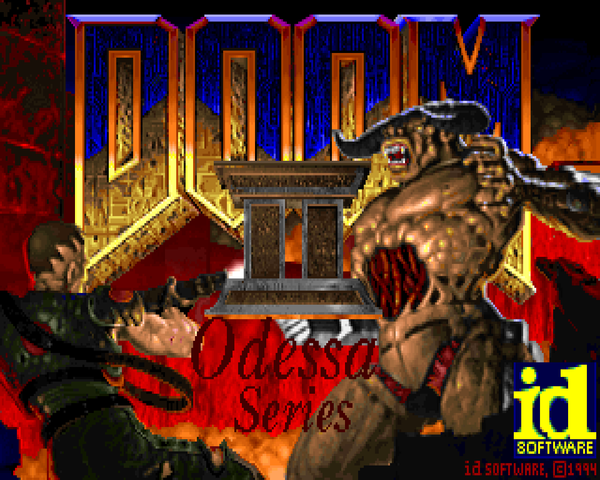
As I mention in the beginning of my review for the first Odessa map, it feels weird to be able to write this article. I've joked about it several times, but I didn't seriously think that I'd ever be in a position to play the rest of the (released) Odessa series. And, yet, here I am, and while it's not exactly what I expected, I'm happy to have experienced them all the same. For a long time, these levels were effectively banned from redistribution, as all of them had a clause restricting them to Compuserve. Eventually, the service changed its scope and with it went the entire user PWAD archive. The only way you could play any of the Odessa levels besides ODESSA14 was, funnily enough, via the shovelware PWAD scrapes that Evans's clause was meant to hinder. Any discussion of them inevitably led to heated exchanges on Doomworld, where authorial intent is followed to the letter.

Wednesday, May 28, 2014

The UCA series


as featured in Super Serials

UCATALPOIDA
DIOPATRASAPIDUSB

To some people, 1994 will always be the worst year of Doom PWADs. To others, be they antiquarians, historians, or just Doom lovers in general, there's a lot of joy to be had in these Promethean works. To be fair, there were still a lot of maps that sucked, but paving over '94 entirely does a grave disservice to the authors that stood above the rest. Eddie Nguyen seemed to have a pretty good grasp on level design, and while his maps have foibles intolerable to modern players (not truly balanced for pistol start, mazes, cramped, repetition, mandatory "secrets"), they are pretty evocative and come with some fairly dense .TXT descriptions that eventually taper off to author commentaries. Nguyen wanted to make a whole episode, too, and you see how that panned out. At least he managed to cap it off, unlike the sorely unresolved INVADE...

Tuesday, May 13, 2014

The KBOOM Series

THE KBOOM SERIES
by Kurt Kesler

as featured in Super Serials

KBOOM_1KBOOM_2KBOOM_3KBOOM_4
KBOOM_5KBOOM_6KBOOM_7KBOOM_8
KBOOM_9KBOOM_10KBOOM_11KBOOM12
BEYOND DEATH

Kurt Kesler made a ton of levels spanning 1997-2001. KMEGA1 encompasses his vanilla works, comprised of KMETL, KBASE and KBRICK, and KHILLS were source port agnostic (limit-removing) maps. KBOOM is a bit more obvious; all of these levels were made to be played in Team TNT's then new Boom engine and use many of its extra editing features. Looking at the list on TNT's webpage here, I think Kesler took advantage of almost all of them. Deep water and faux-3D floors had been around in vanilla with some sector voodoo, but Boom explicitly supported these tricks. Other things like silent teleporters, scrolling floors, and translucence are neat effects that Kurt uses here and there. Well, he uses silent teleporters a lot.

Wednesday, May 15, 2013

The CHORD Series

THE CHORD SERIES
by Malcolm Sailor

as featured in Super Serials
CHORD1CHORD2
CHORD_NGCHORDG
CHORD3

Malcolm Sailor was a pretty prolific author in Doom's heyday. While he was a participant in several famous projects (most notably The Talosian Incident) his real claim to fame is his CHORD series, five single levels released from 1997 to 2000. Not all CHORD levels are created equal; while each showcases Sailor's attitude toward nasty, challenging gameplay, the first two are more embryonic, displaying less of the highly-tuned architecture, detailing and lighting that characterize the latter three. In fact, CHORD2 stands farther apart with a much larger level size, including a vast outer yard with castle battlements that flies in the face of his usually carefully-orchestrated encounters.

Sunday, June 3, 2012

DICKIE Series

THE DICKIE SERIES
by Richard Wiles

as featured in Super Serials

DICKIE01DICKIE02DICKIE03DICKIE04
DICKIE05DICKIE06DICKIE07DICKIE08
DICKIE09DICKIE10

Richard Wiles broke into the Doom mapping community in 1998 by unfurling his DICKIE series in ten installments over the first half of the year. Together, they represent his freshman mapping effort, his first major project before moving onto other critically acclaimed mapsets, like Crusades and SlayeR. Individually, the levels mark the ongoing development of a novice yet talented author looking to improve his skills while trying out a variety of styles, both aesthetic and gameplay. The overall quality of the DICKIE maps increases with each release, reaching its apex at DICKIE10, featured as one of Doomworld's Top 10 WADs of 1998, and for good reason (though the write-up took care to mention the rest of the series).

Sunday, November 20, 2011

The Serenity series

THE SERENITY SERIES
by Holger Nathrath and Bjorn Hermans

as featured in Super Serials

SerenityEternityInfinity
ArachnaTrydentSER3LV11
STRAIN

Holger Nathrath, alongside best buddy and playtester Bjorn Hermans, stand together as two of the most loved '94-'95 PWAD developers, rivaling only Dennis and Thomas Moeller. Their Serenity trilogy spans three episodes for the original Doom and three titles' worth of abstract concepts ending in -ity, but only two years, with Serenity and Eternity seeing release in '94 and Infinity in 1995. And there would have been more! Nathrath and Hermans had two Doom II projects in the pipeline, one a conversion of all the existing Serenity levels to Doom II (perhaps with some more?) and the other an original Doom II megaWAD. We only have scraps available of the latter, namely Bjorn Hermans' own Trydent and Nathrath levels that were donated to other projects, most notably STRAIN with others shopped around to other ambitious projects that never saw release (like the Eternity TC - no official relation).

Monday, October 17, 2011

The Cabal Series

THE CABAL SERIES
by Sverre Andre Kvernmo

as featured in Super Serials

Bloodsea KeepDerelict StationBloodfloodThe Watchtower
Temple of DeathWe Who are About to DieThe Express Elevator to HellEye of the Storm
Mephisto's MaosoleumBlack TowerThe Image of Evil

If Sverre Kvernmo is known for anything, it would be his body of works included in id's Master Levels for Doom II. Less people may know that these works were parts of a work-in-progress megaWAD entitled "The Cabal", which Kvernmo stopped developing when contracted by id. Ever the gentleman, he gathered up the remaining maps and released them to the archives as Cabal 1-7. Together with his four (er, five) Master Levels, they represent one third of his unfinished magnum opus. Though part of me wonders what might have happened if Kvernmo had completed his project, I recognize enough of a quality gap between the freely available maps and his contracted work that I'm grateful for the intervention. I'm sure the experience coupled with his natural talent created the base upon which he built his three astounding Eternal Doom entries.

Saturday, September 24, 2011

The Titan Series

THE TITAN SERIES
by Jim Flynn

as featured in Super Serials

Titan ManorTrapped on Titan
Mines of TitanTitan Anomaly
The Farside of TitanTrouble on Titan

The Titan series was released by Jim Flynn in six separate installments during 1995. Its maps take place on Saturn's most famous moon, hence the title. They follow the adventures of a soldier of the "Alliance", opposite the less scrupulous UAC, as he thwarts both the incumbent demons and easily-corrupted corporation. The explanations for his involvement and justification for lack of armaments become more humorous with each episode, until his pistol is a concession from the military whose hands are tied following an unfavorable evaluation by the psychiatric department (they refuse to believe his mission reports).

Monday, September 12, 2011

The Inferno Series

THE INFERNO SERIES
by John "Dr. Sleep" Anderson

as featured in Super Serials

Dante's GateCrossing AcheronVirgil's Lead
Minos' JudgementNessusGeryon
VesperasLetheChiron

Regrettably, the Inferno series is incomplete. Had John Anderson (aka "Dr. Sleep") ever released Lethe, he would have won Doomworld's Mordeth award, guaranteed. Six of its eight available levels are split between two commercial releases (five in the Master Levels and one in Thy Flesh Consumed), the two earliest entries available in a variety of freeware releases, both Doom and Doom II. The series itself is very loosely based on the first book of Dante's Divine Comedy from which it draws its name, insofar as its protagonist is named Dante, has a buddy named Virgil, and travels through Hell to find his love, Beatrice. Also, I guess, Anderson referred to each installment of Inferno as a canto.